Pricing & Monetisation
Price is where value becomes revenue.
Pricing is one of the highest-leverage decisions in a software business, yet it is often the least examined. We help technology and AI companies design monetisation systems that evolve with the product — not behind it.
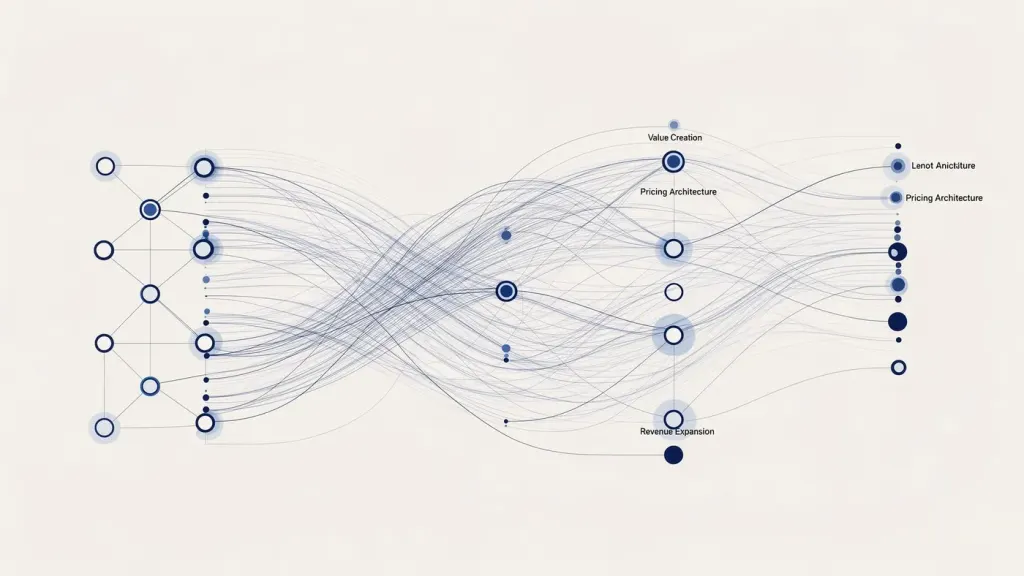
Commercial framework
The Monetisation Framework
Durable monetisation connects three things: how a product creates value, how that value is structured into revenue, and how revenue scales as adoption grows. When these move in sync, pricing becomes a competitive advantage.
Value Creation
How customers derive value from the product.
Includes core capabilities, user workflows, and the specific problems the product eliminates or reduces.
Pricing Architecture
The structures through which value converts to revenue.
Covers pricing models, plan design, packaging boundaries, and metric selection.
Revenue Expansion
Mechanisms that grow revenue as adoption deepens.
Includes seat expansion, usage growth, tier upgrades, and cross-sell pathways.
Misalignment between these layers is the most common source of pricing dysfunction. The product adds capabilities, but the pricing model doesn't reflect them. Customers adopt more deeply, but there's no mechanism to expand revenue. Aligning all three turns monetisation from a periodic exercise into a structural advantage.
Pricing thinking
Pricing is not just a revenue lever. It shapes which customers the product attracts, which capabilities become core, and how usage patterns evolve over time.
When the pricing model is misaligned with the product's value delivery, teams end up building features that increase surface area without improving unit economics. The product gets more complex, but the business does not get more profitable.
Pricing models
Subscription Pricing
Effective when customers receive steady, predictable value. Requires clear packaging and tier logic.
Usage Based Pricing
Ties revenue directly to consumption. Works well for infrastructure, APIs, and metered services.
Hybrid Pricing
Blends a base commitment with variable expansion. Balances predictability for the business with flexibility for the customer.
Product builds value.
Pricing captures it.
Companies that treat monetisation as a core capability, not a one-time decision, consistently build stronger, more defensible businesses.
Every feature has a cost. Every pricing choice has a consequence.
Engineering effort, customer acquisition cost, and margin structure are all shaped by how a product is priced. Treating these as separate conversations leads to products that are expensive to build and difficult to monetise.
Expertise areas
Related
Product Strategy Advisory
→Pricing architecture and product architecture are deeply intertwined. See how we approach product strategy.
Next step
Discuss Monetisation Strategy
If your product has evolved faster than your pricing, or if you are designing a monetisation model from scratch, we are happy to explore the problem with you.
Pricing · Resource
SaaS Pricing Review Checklist
Twenty-eight checks across packaging, value metric, discounting, and renewals — used on day one of pricing engagements.